

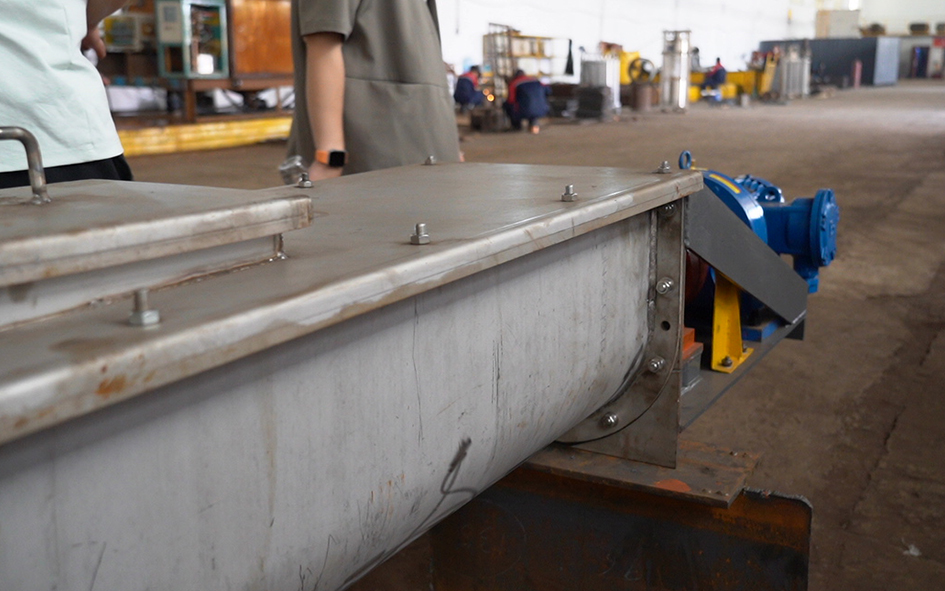
Screw Conveyors are a type of conveying equipment widely used in industries such as chemicals, building materials, power generation, metallurgy, coal, and grain. They are primarily used to convey powdered, granular, and small lump materials. The operating environment temperature ranges from 20 to 50°C, the material temperature is less than 250°C, the conveying angle is less than 20°, and the conveying length is less than 100 meters.
Compared to other conveying equipment, screw conveyors offer advantages such as simple structure, compact cross-sectional dimensions, excellent sealing performance, the ability to load and unload at multiple points along the conveyor, convenient operation, easy maintenance, and suitability for enclosed transport.
Equipment Overview
1. Features multi-section packing seals to ensure no material leakage during long-term operation
2. Equipped with self-lubricating suspension bearings
3. The screw flight and shaft are manufactured with high precision to ensure coaxial alignment
Screw Diameter (mm) | 100 | 160 | 200 | 250 | 315 | 400 |
Thread Pitch (mm) | 100 | 160 | 200 | 250 | 315 | 355 |
Rotational Speed (r/min) | 71-140 | 50-112 | 50-100 | 45-90 | 40-80 | 36-71 |
Throughput (m³/h) | 1.1-2.2 | 4-8 | 7-14 | 13-24 | 16-34 | 34-64 |
Screw Diameter (mm) | 500 | 630 | 800 | 1000 | 1250 | |
Thread Pitch (mm) | 400 | 450 | 500 | 560 | 630 | |
Rotational Speed (r/min) | 32-63 | 25-50 | 20-40 | 16-32 | 13-25 | |
Throughput (m³/h) | 52-100 | 80-145 | 110-208 | 150-300 | 200-388 |
Screw Conveyor: An Essential Solution for Efficient Material Handling
A Screw Conveyor is one of the most widely used mechanical conveying systems in industries that need to move bulk materials in a controlled and efficient manner. It is valued for its simple structure, reliable performance, and ability to transport a wide range of materials, including powders, granules, flakes, and semi-solid substances. From agriculture and food processing to mining, wastewater treatment, construction, and chemical production, the Screw Conveyor plays a critical role in improving workflow, reducing manual labor, and increasing productivity.
The basic principle of a Screw Conveyor is straightforward. A rotating helical screw blade, known as a flight, moves material along a trough or enclosed tube as it turns. This motion creates continuous transportation from one point to another. Because of its design, the Screw Conveyor can handle horizontal, inclined, and even vertical conveying applications depending on the configuration and material requirements.
How a Screw Conveyor Works
The operation of a Screw Conveyor depends on the rotation of the screw shaft inside a casing or trough. When the shaft rotates, the screw flights push the material forward. The material does not rotate with the screw in a perfect circle; instead, it is gradually advanced along the conveyor path due to the friction and resistance between the material and the housing.
There are different types of Screw Conveyor systems, but the core working principle remains similar. In many designs, the conveyor includes a motor, gearbox, drive shaft, bearings, screw blade, and housing. The motor provides the rotational force, while the gearbox adjusts speed and torque according to the material characteristics and required capacity. The housing keeps the material contained, minimizing spillage, dust, and contamination.
This simple yet effective mechanism makes the Screw Conveyor a practical choice for many industrial operations. It can be installed in compact spaces, integrated with other machinery, and customized to suit specific processing needs.
Main Advantages of a Screw Conveyor
One of the biggest advantages of a Screw Conveyor is its versatility. It can transport a broad range of materials, from fine dust to heavy bulk solids. Depending on the screw design and the material being handled, it can be used for dry, wet, sticky, or abrasive products.
Another major benefit is its enclosed construction. In many industries, controlling dust and maintaining cleanliness are important. A Screw Conveyor helps prevent material leakage and reduces exposure to the surrounding environment. This is especially useful when handling food ingredients, chemicals, fertilizers, or hazardous substances.
Maintenance requirements are generally low compared with some other conveying systems. The structure is relatively simple, and there are fewer moving parts than in many alternative transportation methods. This can lead to lower operating costs and less downtime, provided the system is properly maintained.
A Screw Conveyor is also known for its space-saving design. It can fit into narrow or irregular plant layouts where other types of conveying equipment may be difficult to install. The system can be mounted horizontally, at an angle, or vertically, making it highly adaptable.
In addition, the Screw Conveyor offers controlled material flow. Operators can regulate the speed of the screw to match production requirements, ensuring steady and predictable transfer. This is particularly valuable in batching, dosing, mixing, and feeding applications.
Common Applications of Screw Conveyor Systems
The Screw Conveyor is used across many industries because of its adaptability and efficiency. In agriculture, it is commonly used to move grains, seeds, animal feed, and fertilizers. These materials are often handled in large volumes, and the Screw Conveyor provides a dependable way to transport them from storage bins to processing or packaging equipment.
In the food industry, a Screw Conveyor may transport flour, sugar, spices, starch, coffee grounds, and other dry ingredients. Food-grade materials often require sanitary conditions and gentle handling, both of which can be supported by an appropriately designed conveyor system.
In mining and construction, the Screw Conveyor is used for transporting cement, sand, ash, crushed minerals, and other bulk solids. These materials can be abrasive and heavy, so the conveyor must be built with durable components and wear-resistant surfaces.
Wastewater treatment facilities also make use of Screw Conveyor systems to remove sludge, screenings, and other waste materials. In such environments, the conveyor helps automate a process that would otherwise require significant manual effort.
In the chemical and pharmaceutical sectors, precise and safe handling is essential. A Screw Conveyor can be used to transfer powders and granules while minimizing contamination and maintaining product integrity. For applications requiring strict cleanliness or corrosion resistance, stainless steel and specialized coatings are often chosen.
Types of Screw Conveyor
There are several common forms of Screw Conveyor, each designed for specific operating conditions.
A horizontal Screw Conveyor is one of the most common types. It is used for moving materials over a level distance and is suitable for many standard conveying tasks. Because of its simplicity and efficiency, it is widely applied in industrial plants.
An inclined Screw Conveyor is used when material needs to be transported upward at an angle. As the angle increases, conveying capacity usually decreases, so system design must account for reduced efficiency and possible backflow.
A vertical Screw Conveyor is designed for lifting material straight up. It saves floor space and is useful when transferring material between levels. However, vertical conveying typically requires careful engineering to ensure stable movement and prevent clogging.
A shaftless Screw Conveyor is another important variation. It does not use a central shaft, which makes it suitable for sticky, fibrous, or entangling materials that might wrap around a conventional shaft. This type is often found in wastewater and waste management applications.
A flexible Screw Conveyor uses a rotating flexible screw inside a tube. It is often chosen for light bulk materials and situations where routing around obstacles is necessary. It is easy to install and can be moved or reconfigured relatively quickly.
Design Considerations for a Screw Conveyor
Proper design is essential to ensure that a Screw Conveyor operates efficiently and lasts a long time. Several factors must be considered before selecting or installing a system.
First, the nature of the material is critical. Particle size, moisture content, abrasiveness, density, and flowability all influence the choice of screw diameter, pitch, speed, and material of construction. For example, abrasive products may require hardened components, while food products may need sanitary surfaces.
Second, the conveying capacity must be determined. The conveyor should be able to handle the required volume without overloading. If the capacity is too low, production efficiency will suffer. If it is too high, the system may become unnecessarily expensive or difficult to control.
Third, the conveying distance and angle must be evaluated. Longer distances and steeper inclines usually require more power and may reduce efficiency. Engineers must calculate torque, speed, and load conditions to match the application.
Fourth, the choice of housing and screw materials affects durability and performance. Carbon steel is common for general industrial use, while stainless steel is often used for corrosion resistance and hygiene. Wear liners or special coatings may be added for abrasive materials.
Fifth, maintenance access should be included in the design. Even a well-built Screw Conveyor requires periodic inspection of bearings, seals, drive components, and screw flights. Easy access improves reliability and reduces downtime.
Maintenance and Operation
To ensure long-term performance, a Screw Conveyor should be operated and maintained correctly. Regular inspection is important to identify wear, misalignment, loose fasteners, or buildup of material inside the housing. Lubrication of bearings and drive components should follow recommended intervals.
Operators should avoid overloading the conveyor, as this can increase wear and reduce service life. Material buildup should be removed promptly to prevent blockages or damage to the screw flight. In applications involving sticky or damp materials, cleaning schedules may need to be more frequent.
Monitoring the motor load and vibration can also provide useful information about the system condition. If the conveyor begins drawing excessive power, it may indicate a jam, worn components, or incorrect operating settings.
Proper training is another important factor. Operators should understand how the Screw Conveyor works, how to start and stop it safely, and how to recognize signs of abnormal operation. Safe procedures help protect both equipment and personnel.
Future Development of Screw Conveyor Technology
Although the Screw Conveyor is a traditional piece of equipment, it continues to evolve with modern industrial needs. Improvements in materials, automation, and monitoring systems are making conveyors more efficient and intelligent. Sensors can now be added to track speed, torque, temperature, and vibration, helping operators detect problems before failures occur.
Energy efficiency is also becoming a greater focus. New drive technologies and optimized screw designs can reduce power consumption while maintaining performance. In addition, more attention is being given to hygienic design, environmental protection, and modular structures that simplify installation and expansion.
As industries become more automated, the Screw Conveyor will continue to be an important part of integrated material handling systems. Its ability to move bulk materials reliably, safely, and economically ensures that it remains relevant in both established and emerging industrial applications.
Conclusion
The Screw Conveyor is a highly practical and widely used material handling solution with a strong reputation for simplicity, durability, and versatility. Its ability to move a wide variety of bulk materials in horizontal, inclined, or vertical directions makes it indispensable in many industries. Whether handling grains, powders, sludge, minerals, or chemicals, the Screw Conveyor offers controlled transport, low maintenance, and efficient operation.
With proper selection, thoughtful design, and regular maintenance, a Screw Conveyor can provide many years of dependable service. As industrial processes continue to demand greater efficiency and cleaner handling methods, the Screw Conveyor will remain an essential tool in modern production and processing environments.
This website uses cookies to ensure you get the best experience on our website.
 Español
 Pусский
 العربية
 Tiếng Việt



 WhatsApp
 Phone: