
 Español
 Pусский
 العربية
 Tiếng Việt
Trough Idlers
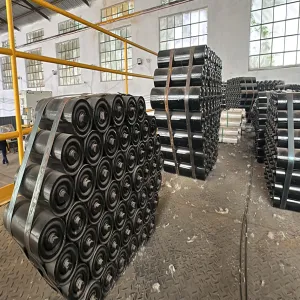
Trough idlers are essential components used in conveyor systems to support the conveyor belt and carry bulk materials efficiently. They are widely applied in industries such as mining, quarrying, cement production, power generation, ports, and agriculture. Their main function is to form the belt into a trough shape, which increases the carrying capacity of the conveyor and helps prevent material spillage during transportation.A trough idler typically consists of one horizontal or center roll and two inclined side rolls, arranged in a set to create a concave profile. This design allows the conveyor belt to cradle the transported material more effectively than a flat arrangement. The angled side rolls help keep the belt centered and stabilize its movement, especially when handling heavy, abrasive, or uneven loads. Depending on the application, the troughing angle may vary, with common angles including 20°, 35°, and 45°.The construction of trough idlers is designed for durability and reliable performance. The rolls are usually made from high-quality steel tubing or other wear-resistant materials, while the shafts are manufactured from precision-machined steel to ensure strength and smooth rotation. Sealed bearings are commonly used to reduce friction, extend service life, and protect against dust, moisture, and contaminants. The shell surface may be treated with anti-rust coatings or special finishes to improve resistance to harsh working conditions.One of the key advantages of trough idlers is their ability to enhance conveyor efficiency. By supporting the belt in a trough shape, they help increase the load volume and improve material control. This reduces the chance of material falling off the belt, which can lower cleanup costs and improve workplace safety. In addition, well-designed trough idlers contribute to reduced belt wear, smoother operation, and lower energy consumption.Trough idlers are available in different sizes and configurations to suit various conveyor widths and operational requirements. They can be used in standard-duty, heavy-duty, or extra-heavy-duty applications. Some designs also include impact trough idlers, which are installed at loading points to absorb shock and protect the belt from damage caused by falling materials. Return idlers, transition idlers, and training idlers are often used alongside trough idlers to ensure the conveyor system operates correctly and efficiently.Maintenance is an important factor in extending the life of trough idlers. Regular inspection helps identify worn rollers, damaged bearings, misalignment, or excessive vibration before they lead to system failure. Proper lubrication, cleaning, and timely replacement of components can significantly improve performance and reduce downtime.In summary, trough idlers play a vital role in conveyor belt systems by supporting the belt, shaping it into a trough, and enabling safe and efficient material transport. Their robust construction, versatility, and ability to improve conveying performance make them an indispensable part of modern bulk material handling operations.
Products
Category:
-
Cushion Idlers
Category: Auxiliary and Transport ComponentsBrowse number: 133Number:Release time: 2026-07-06 11:44:04Cushion idlers, also known as rubber-coated idlers or impact-absorbing idlers, represent a specialized category of conveyor idler rollers designed to provide enhanced protection for conveyor belts and the materials being transported. Unlike standard steel idlers, cushion idlers feature a resilient outer layer of rubber or synthetic elastomer bonded to the steel roller core. This rubber covering serves multiple critical functions: absorbing impact energy from falling materials, reducing vibration and noise, improving belt traction, and minimizing wear on both the belt and the idler structure it...
News
Category:
No search results found!
Case
Category:
No search results found!
Video
Category:
No search results found!
Download
Category:
No search results found!
Job
Category:
No search results found!
Featured Products
No search results found!



 WhatsApp
 Phone: