

Equipment Overview
A Cast Iron Machine consists of a circulating chain conveyor equipped with a series of molds. Molten iron is poured sequentially into the moving molds at one end; the molten iron cools as the molds travel along the conveyor. When the molds reach the tail end of the cast iron machine and begin moving in the opposite direction, the solidified castings automatically fall out of the molds. The cast iron machine is a critical piece of equipment in blast furnace cast iron production; its operational stability directly affects the continuity of cast iron production and the improvement of casting efficiency.
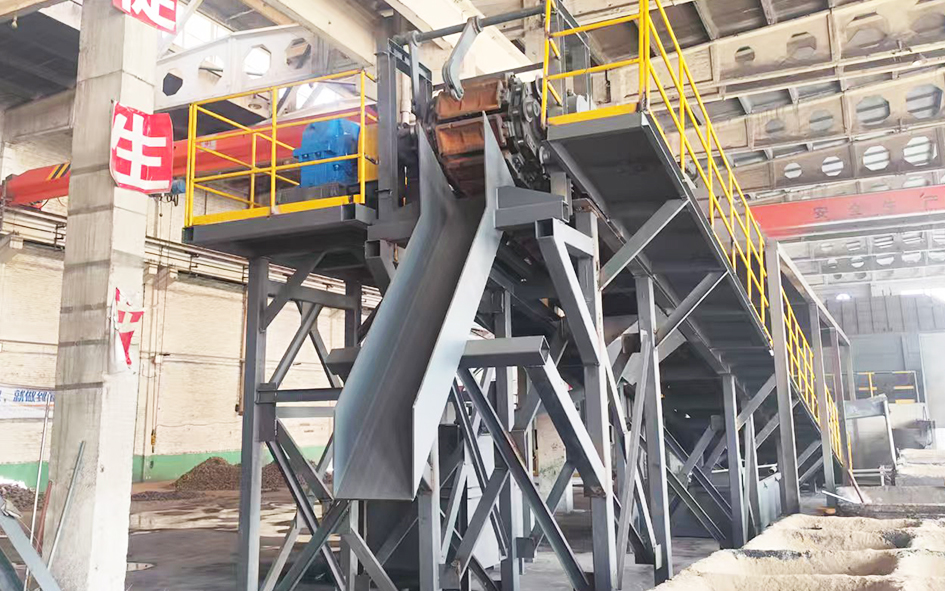
Table of Main Technical Specifications for the Double-Chain, Roller-Guided, Stationary Cast Iron Machine | |||||||
Specifications | 75 m | 60m | 50 m | 45m | 40m | 35m | |
Center-to-center distance between drive and driven chains (m) | 74.82 | 75 | 60 | 50.4 | 45 | 40.2 | 35.4 |
Cast Iron Machine Design Capacity (t/h, MAX) | 450 | 400 | 230 | 165 | 150 | 135 | 120 |
Design Production Capacity of the Cast Iron Machine (t/d, 69% operating rate, MAX) | 4500 | 4000 | 2500 | 1650 | 1500 | 1350 | 1200 |
Chain Conveyor Operating Speed (m/min) | 13~16 | 13~16 | 9.5~ | 8.5~ | 7.5~ | 6.5~8.5 | |
Chain Belt Inclination (°) | 6~9 | ||||||
Sprocket Pitch Circle Diameter (mm) | 2247.3 | 1942 | 1567.8 | ||||
Chain Pitch (mm) | 860 | 600 | |||||
Chain Center Distance (mm) | 2800 | 2500 | |||||
Center-to-center distance of chain plates (mm) | 1200 | 900 | |||||
Distance between cast iron molds (mm) | 430 | 300 | 300 | ||||
Note: The specifications above are for reference only. | |||||||
The term "cast iron machine" encompasses a broad category of industrial equipment where the primary structural material is cast iron. This is not a single specific machine but rather a class of machinery defined by its construction material, which imparts distinct characteristics and advantages. Cast iron, as a material, has been foundational to industrial development since the eighteenth century, and its application in machine construction remains as relevant today as it was during the height of the Industrial Revolution. The enduring presence of cast iron in manufacturing is a testament to its unique combination of properties, which are exceptionally well-suited to the demands of heavy machinery and precision workholding.
The fundamental concept of a cast iron machine relies on the use of iron that has been melted, poured into a mold, and allowed to solidify into the desired shape. This casting process is what gives the material its name and its primary characteristic: the ability to form complex, rigid, and durable shapes in a single piece. This is a significant advantage over fabrication methods that involve assembling multiple smaller components, as it eliminates potential weak points like welds or bolted joints. The resulting machine bases, frames, and components are monolithic structures known for their stability, strength, and capacity to withstand the immense forces, vibrations, and thermal stresses that are common in industrial environments.
The fundamental value of a cast iron machine is rooted in the material's inherent physical properties. Cast iron's high compressive strength makes it ideal for supporting heavy loads without deformation, while its natural damping capacity, or ability to absorb vibrational energy, is critical for precision operations. When a machine tool operates, cutting forces generate vibrations; if these are not effectively dampened, they can lead to chatter, poor surface finish, and reduced tool life. Cast iron's microstructure, particularly the presence of graphite flakes or nodules depending on the specific type, acts as an internal shock absorber, dissipating this energy and ensuring a smoother, more stable operation. This is why cast iron remains the material of choice for the beds and columns of high-precision machine tools, such as lathes, milling machines, and grinding machines.
The performance and application of a cast iron machine are highly dependent on the specific grade of cast iron used. The material is not a single uniform substance but a family of alloys, each with distinct mechanical and physical properties. The most common types encountered in machine construction are gray cast iron, ductile cast iron, and, to a lesser extent, malleable cast iron. Understanding the differences between these is crucial for selecting the right machine for a given task.
Gray cast iron is the most widely used type and is often considered the standard for industrial machinery. It is characterized by the presence of flake-like graphite particles within its structure. These graphite flakes are what give the material its gray appearance on a fractured surface and are also responsible for its excellent vibration-damping properties. Gray cast iron is relatively easy to cast and machine, making it a cost-effective choice for complex, large components like machine bases, pump housings, and engine blocks. Its primary limitations are its brittleness and relatively low tensile strength compared to steel. It is not suitable for applications involving significant bending or impact loads, but for compressive loads and vibration suppression, it is unmatched.
Ductile cast iron, also known as nodular or spheroidal graphite iron, is a more modern development that offers a significant improvement in mechanical properties over gray cast iron. Through a process of adding a small amount of magnesium or cerium during the casting process, the graphite is forced to form in a spherical shape rather than flakes. This microstructural change dramatically increases the material's tensile strength and ductility, giving it properties much closer to steel while retaining many of the beneficial attributes of cast iron, such as its good castability and wear resistance. Ductile cast iron is a superior choice for machines that are subjected to more demanding stresses, including shock loads and higher pressures. It is often used in high-performance automotive components, heavy-duty pumps, and critical structural parts where a higher strength-to-weight ratio is required.
Malleable cast iron represents a third category, produced by heat-treating white cast iron to convert its carbon from a brittle carbide form into graphite clusters. This process results in a material with excellent toughness and ductility, often superior to gray cast iron, though generally not as strong as ductile cast iron. Its primary advantage lies in its good machinability and impact resistance. In the context of machines, malleable cast iron is more commonly used for smaller, intricate components such as brackets, fittings, and chain links rather than the main load-bearing frames. Its application is more specialized, filling a niche where a balance of toughness and machinability is paramount.
The application of cast iron machines spans a vast array of industrial sectors, from heavy manufacturing to precision engineering and critical infrastructure. The common thread is the need for robust, reliable, and stable equipment that can operate continuously under demanding conditions. The specific application dictates the type of cast iron machine and its design.
In the realm of machine tools, cast iron is absolutely dominant for the structural components. The bed of a large engine lathe, the column of a vertical milling machine, and the base of a surface grinder are almost invariably made from cast iron. The reason for this is the material's unrivalled ability to maintain geometric accuracy over long periods and under heavy cutting loads. The mass of a cast iron machine base provides inherent rigidity, counteracting the forces generated by the cutting tool. Simultaneously, the damping capacity prevents the onset of regenerative chatter, a phenomenon where tool vibrations leave a wavy pattern on the workpiece, which can ruin precision and accelerate tool wear. In high-precision industries like aerospace and mold-making, where tolerances are measured in microns, the stability offered by a cast iron machine is not a luxury but a strict necessity.
The pumping industry is another major domain for cast iron machines. Centrifugal pumps, positive displacement pumps, and large industrial compressors rely heavily on cast iron for their casings, impellers, and bases. The material's excellent corrosion resistance in many environments, combined with its ability to withstand high pressures and temperatures, makes it a reliable choice for moving water, chemicals, oils, and slurries. A cast iron pump casing is designed to contain the internal pressure without leaking, while the impeller, often also made of cast iron, must resist the erosive wear caused by the fluid passing over its blades at high speed. In municipal water systems, agricultural irrigation, and chemical processing plants, cast iron pumps are the workhorses that ensure the continuous, dependable movement of fluids.
The construction and mining sectors depend on cast iron for a different class of machinery. Large rock crushers, heavy-duty conveyor systems, and the massive gearboxes used in excavators and haul trucks frequently employ cast iron for their frames and housings. In these applications, the machine must survive in the harshest conditions imaginable: intense shock loads, heavy abrasion from rocks and dirt, and exposure to the elements. The mass and durability of cast iron provide the necessary resistance to impact and wear. A cast iron crusher frame must be able to withstand the tremendous forces of breaking boulders, while a conveyor idler housing made of cast iron protects the bearings from damage in a gritty environment.
In the agricultural sector, cast iron machines are similarly indispensable. The chassis and engine blocks of large tractors, the housings of balers and harvesters, and the components of grain handling equipment are often made from cast iron. These machines operate in fields, exposed to dust, moisture, and uneven terrain. The ability of cast iron to dampen vibration from the engine and the implement reduces operator fatigue and protects sensitive components. Its durability ensures that the machine can withstand the long, arduous seasons of planting and harvesting with minimal downtime. The simple, robust design of a cast iron pump or gearbox is easy to maintain in remote locations, which is a significant practical advantage for farmers.
The power generation industry is yet another critical area. Large diesel and gas generator sets, which serve as backup power sources for hospitals, data centers, and manufacturing plants, have engine blocks and base frames made of cast iron. These components must handle the extreme heat and pressure of internal combustion while providing a stable platform to minimize vibration transmission to the surrounding building. Additionally, steam turbines in power plants and the housings for large electrical transformers often employ cast iron due to its good electrical and magnetic properties, as well as its structural stability.
Proper operation of a cast iron machine is essential not only for achieving the desired output but also for ensuring the machine's longevity and the safety of the personnel involved. While every specific machine will have its own unique manual, a set of general principles applies to the operation of all cast iron equipment. These principles center on preparation, monitoring, and maintenance.
Before starting any cast iron machine, a thorough pre-operational inspection is crucial. The operator should visually inspect the machine for any obvious signs of damage, such as cracks in the cast iron housing or frame. While cast iron is robust, it is susceptible to impact damage, which can propagate into stress fractures. The operator should also check all guards and safety devices to ensure they are in place and functioning correctly. This includes emergency stop buttons, light curtains, and machine enclosure doors. All lubrication points should be checked to ensure they have an adequate supply of the correct lubricant. Many cast iron machines, particularly older ones, rely on a system of oil cups and grease fittings that require regular manual attention. The operator should also verify that the work area is clear of obstructions and that all necessary tools and workpieces are ready.
The process of starting up the machine should be gradual and deliberate. For larger machinery, it is standard practice to run the machine at a low speed for a brief warm-up period. This allows the lubricating oil to reach all moving parts and the metal components to reach a stable operating temperature. Cast iron, like all metals, expands as it heats up, and a controlled warm-up prevents thermal shock and ensures that critical clearances are maintained. During this warm-up period, the operator must listen carefully for any unusual sounds. A knocking or grinding noise can indicate a loose component, a bearing failure, or a lack of lubrication, all of which can lead to catastrophic damage if ignored. Similarly, the operator should observe any gauges, such as temperature or pressure indicators, to confirm they are reading within normal parameters.
During the actual operation, the operator must maintain a constant state of awareness. The machine's workload should be kept within its designed capacity. Overloading a cast iron machine, whether by taking too deep a cut on a lathe or forcing too much material through a pump, subjects the frame to stress beyond its intended limits. This can cause permanent deformation or, in extreme cases, a brittle failure. The operator must also monitor the tooling. A dull cutting tool or an unbalanced impeller will create additional vibration, which can be transmitted to the cast iron structure. While the material has excellent damping properties, it is not immune to fatigue, and prolonged excessive vibration can shorten its service life. Finally, the operator must always keep a clear view of the workpiece and the tool interaction point, staying ready to actuate the emergency stop if any unexpected event occurs.
Shutting down the machine is the final step in a safe operating cycle. The operator should not simply cut power to the machine, especially under heavy load. Instead, the feed and speed should be reduced first to allow the machine to wind down in a controlled manner. After the machine has come to a complete stop, a post-operation inspection is recommended. The operator should clean the machine of any chips, dust, or debris that have accumulated, as these can attract moisture and lead to corrosion. The operator should also make a final check of the lubricant levels and make note of any irregularities that occurred during the shift. This attention to the shutdown process helps to ensure that the machine will be ready for a safe and productive start during the next shift.
Despite their robust and reliable nature, questions and issues inevitably arise during the ownership and operation of cast iron machines. Understanding the most common of these can help users troubleshoot problems and maintain their equipment effectively.
One of the most frequent concerns is the repair of a cracked cast iron component. Due to its relatively brittle nature, a heavy impact or a significant overload can cause a crack to develop in a machine frame or housing. The traditional approach to repairing such damage has been welding, but this is a challenging and specialized process. Cast iron, particularly gray cast iron, has a high carbon content. When it is heated by welding, the carbon can form hard, brittle compounds in the heat-affected zone, which can cause new cracks to form as the weld cools. Successful repair often requires preheating the entire component to a high temperature, welding with special nickel-based electrodes, and then slowly cooling the piece to prevent thermal shock. An alternative to welding is the use of metal stitching, a cold repair process where a series of interlocking metal fasteners are installed across the crack to draw it back together. This method does not introduce high heat and is often preferred for repairing cracked machine frames where dimensional stability is paramount. In many cases, however, the most cost-effective solution for a severely cracked component is simply to replace it with a new casting.
Another common area of inquiry involves the prevention of corrosion and rust. Cast iron is susceptible to oxidation when exposed to moisture and air. While the formation of a thin surface layer of rust is often superficial and may not affect the structural integrity, it can degrade the aesthetic appearance and, more importantly, damage critical mating surfaces or precision ways. The primary defense against corrosion is proper surface protection. Machine beds and precision surfaces are typically coated with a thin film of oil or a specialized rust-preventative compound during periods of non-use. For machines that are stored outdoors or in humid environments, a heavier coating of grease may be used. In addition, regular cleaning and the prompt removal of any accumulated water or cutting fluid from the machine surfaces are essential practices. Painting is the other main form of protection, with high-quality industrial primers and topcoats applied to all non-machined surfaces to form a barrier against the environment.
The issue of how to improve the precision of a cast iron machine is a frequent topic among operators. Over time, the precision ways or guide surfaces of a machine tool can wear, leading to a loss of accuracy. The remedy for this is a process known as scraping. This is a manual process where a hand tool called a scraper is used to remove microscopic amounts of metal from the high spots on a surface. The surface is first coated with a marking compound, and then it is rubbed against a precise reference plate. The high spots, where the compound has transferred to the reference plate, are then scraped away. This labor-intensive process is repeated until the entire surface is uniformly flat. While time-consuming, hand scraping can restore a machine to a level of precision that is difficult to achieve with other methods. It also creates a surface that holds oil well, reducing friction and wear.
Finally, a common question revolves around the transportation and installation of a Heavy Cast Iron Machine. Moving a piece of equipment that may weigh several tons requires specialized planning. The primary concern during transport is to support the machine in a way that does not induce stresses that could cause warping or cracking. Machines are typically lifted by their designated lifting points using slings or chains. Once the machine is in its new location, the installation of a proper foundation is critical. For large machine tools, a concrete foundation may be required to provide a stable base and to isolate the machine from vibrations from the surrounding environment. The machine is then leveled using precision machinist's levels placed on the finished guide surfaces. Once level, anchor bolts are usually tightened to secure the machine. The process of leveling and aligning a large cast iron machine is critical, as any twist in the base will be reflected in the work produced by the machine.
In conclusion, the cast iron machine, in its many forms, is a cornerstone of modern industry. Its enduring popularity is a direct result of the unique and beneficial properties of cast iron as a material. The machine's ability to provide a rigid, stable, and vibration-damping structure ensures its place in precision manufacturing, heavy industry, and critical infrastructure around the world. Understanding the different types of cast iron, the broad range of applications, the correct operating procedures, and the solutions to common problems is essential for anyone involved in the selection, operation, or maintenance of these fundamental pieces of industrial equipment. The legacy of cast iron in machinery is not just a historical footnote but a living technology that continues to evolve and adapt to new challenges.
This website uses cookies to ensure you get the best experience on our website.
 Español
 Pусский
 العربية
 Tiếng Việt



 WhatsApp
 Phone: