

Rail-guided Electric Flatbed Carts, also known as rail transfer trolleys, track flat cars, or electric rail vehicles, represent a specialized category of material handling equipment designed for heavy-duty industrial transportation along fixed rail paths. Unlike their rubber-tired counterparts that offer flexibility in navigation, rail-guided carts operate on dedicated steel tracks, providing unmatched stability, precise positioning, and the capacity to handle extraordinarily heavy loads—ranging from a few tons to several hundred tons, with some engineered solutions reaching up to 1,300 tons.
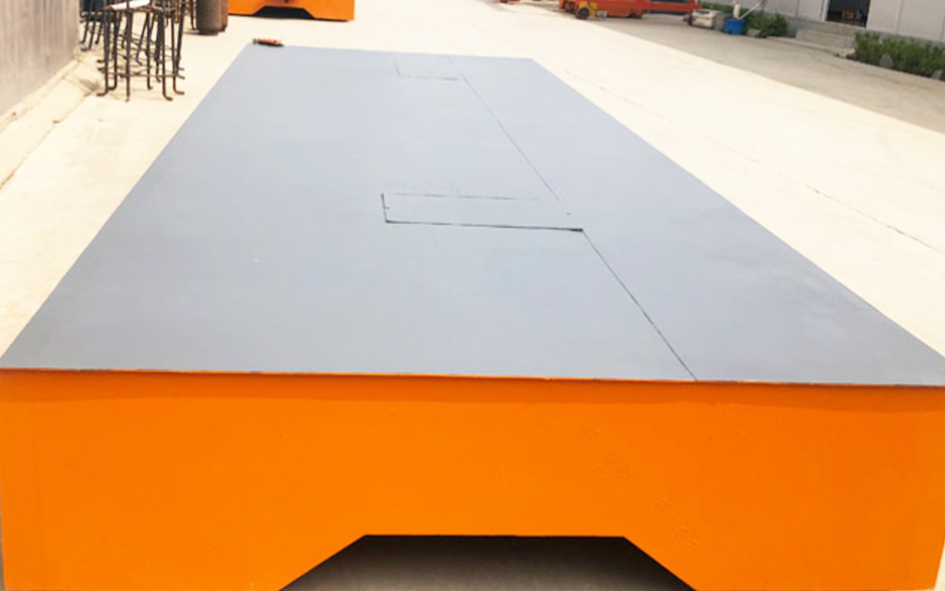
The fundamental design consists of a robust, flat platform mounted on a wheeled carriage that runs on steel rails. The frame is typically constructed from high-strength welded steel using a box-beam or channel steel structure, often employing an eight-point bearing configuration to distribute the load evenly and reduce the overall table height. The drive system comprises an electric motor paired with a reduction gearbox to deliver high torque, along with the necessary electrical control systems and power supply mechanisms. The vehicle is characterized by its flat bottom and absence of a carriage cover, making it ideal for transporting oversized, irregular, or heavy industrial items.
The defining feature of these carts is their reliance on a fixed rail path. The rails bear the massive vertical loads, making this the most stable heavy lifter in heavy industry. While the cart itself has no steering mechanism—movement is confined to forward and backward along the tracks, with turns dictated by the rail layout—this limitation is a trade-off for the exceptional load capacity, precision, and reliability these systems provide. They are indispensable in environments where consistent, repeatable transport of massive loads is required, such as steel mills, foundries, heavy fabrication plants, and automated production lines.
Classification by Power Supply Method
One of the most critical distinctions among Rail-Guided Electric Flatbed Carts lies in their method of power supply. Each configuration offers unique advantages and limitations, making them suitable for different operational environments and requirements.
Cable reel powered carts receive electrical power through a cable wound on a motorized reel mounted on the cart itself. The cable is connected to a fixed power source on the floor, and as the cart moves, the reel automatically pays out or winds up the cable to maintain proper tension using a hysteresis coupling mechanism. This system provides a reliable and straightforward power supply using standard industrial alternating current power. The primary limitation is the operational range, which is typically restricted to distances of less than 200 meters due to the physical constraints of the cable length and the reel capacity. These carts are best suited for applications where the travel path is relatively short and predictable, such as shuttling materials between adjacent workstations or across a single production bay.
Battery powered carts utilize onboard rechargeable battery packs—either lead-acid, gel, or increasingly lithium-ion—to supply power to the drive motor. This configuration offers the greatest operational flexibility, as the running distance is not limited by cables or track power constraints. The absence of cable connections also eliminates the need for track insulation, simplifying installation and reducing initial infrastructure costs. These carts are highly maneuverable in the sense that they are not tethered to a fixed power source, though they remain bound to the rails for guidance. They are ideal for facilities where the travel path is long, where cables would pose a tripping hazard or be impractical, or where multiple carts need to operate interchangeably across different rail sections. The main considerations are battery management, charging time, and battery lifespan, which typically ranges from three to five years for lead-acid types and up to eight to ten years for lithium-ion variants.
Low-voltage rail powered carts draw power directly from the rails themselves. In this system, a ground-based transformer steps down the standard supply voltage to a safe low voltage—typically 36V three-phase or single-phase—which is then fed to the conductive rails. The cart picks up this low-voltage power through conductive devices mounted on its wheels or special pickup shoes, and an onboard step-up transformer raises the voltage back to the level required by the drive motor. This system offers virtually unlimited travel distance, as power is available continuously along the entire rail length. However, it requires careful rail insulation to prevent short circuits and ensure operator safety. Starting currents can be substantial, which can cause voltage drops at the rail ends, potentially affecting motor starting performance. For this reason, single-phase low-voltage rail carts are generally limited to loads of fifty tons or less, while three-phase systems are used for higher capacities.
Trolley line powered carts draw power from an overhead or side-mounted conductor bar system, similar to the trolley poles used on electric streetcars. The cart is equipped with a collector arm that maintains contact with the live conductor, providing continuous power along the entire travel path. This system offers unlimited travel distance without the complexity of rail insulation, though it requires careful installation and maintenance of the conductor infrastructure.
Application Scenarios
The unique characteristics of rail-guided electric flatbed carts make them the preferred solution in specific industrial contexts where heavy loads, precision, and reliability are paramount.
In heavy manufacturing and steel production, these carts are essential for transporting steel coils, slabs, billets, and finished products across production floors. They are frequently used in foundry melting shops, continuous mold stamping lines, and steel coil turnover operations. The ability to withstand harsh conditions, including high temperatures and heavy debris, makes them particularly suitable for these environments. Some carts are even equipped with specialized high-temperature resistance features to protect against radiant heat and splatter.
In assembly lines and automated production facilities, rail-guided carts serve as mobile workstations that shuttle components between assembly stations. They can be integrated with automated production lines, enabling synchronized material flow and just-in-time delivery of parts. The positioning accuracy of these carts—often within five millimeters or better—allows for precise docking with conveyor systems, robotic cells, or other automated equipment.
The assembly of large structures such as aircraft fuselages, ship sections, or heavy machinery benefits from the stability and load capacity of rail-guided carts. These carts can transport massive subassemblies across the assembly floor, positioning them with precision for joining operations. The fixed path ensures repeatable movement, while the low profile design facilitates easy access for workers and lifting equipment.
Foundries utilize rail-guided carts to transport molten metal ladles, sand molds, and castings across the plant. The heat-resistant variants of these carts are designed to operate in close proximity to furnaces and pouring stations, where temperatures can be extreme. The robust construction and reliable operation are essential in these demanding conditions, where equipment failure could result in production stoppages or safety incidents.
Specialized rail-guided flatbed carts are also used in railway maintenance applications. Heavy-duty rail carts are employed by railway engineering departments to transport steel rails, turnout assemblies, sleepers, tools, and other materials for track maintenance and repair. Some variants are equipped with hydraulic lifting or crane mechanisms for loading and unloading operations. These carts are designed to operate on standard-gauge railway tracks and may include features such as air braking systems and high-speed running capability for mainline applications.
Construction and Mechanical Design
The mechanical design of rail-guided electric flatbed carts is characterized by robust construction and careful engineering to ensure reliability under extreme loads.
The frame forms the backbone of the cart, typically fabricated from large channel steel or box-section steel members. A common design uses four longitudinal beams connected by several cross beams and planks, forming a rigid welded structure. The eight-point bearing arrangement distributes the load evenly across the frame, reducing stress concentrations and enabling a lower table height—the platform typically sits just 450 to 750 millimeters above the rail surface, facilitating loading and unloading.
The wheel assemblies are critical components, with wheels typically cast from high-grade steel and surface-hardened to resist wear. The wheels are mounted on axles made from quenched and tempered steel, using double-row radial spherical roller bearings that can automatically compensate for frame deformation and misalignment. For low-voltage rail powered carts, the wheels and axles must incorporate electrical insulation to prevent short circuits. This is achieved using insulating sleeves and washers made from materials with high mechanical and electrical insulating properties. The wheels are not directly grounded to the frame, isolating the power circuit and ensuring safe operation.
The drive system typically consists of an electric motor coupled to a reduction gearbox that provides the necessary torque multiplication. The transmission transfers power from the gearbox to one or both wheel axles, depending on the design. Speed control is usually achieved through variable frequency drives, providing smooth acceleration and deceleration and enabling precise positioning.
Rail-guided carts are equipped with sophisticated control systems that manage power delivery, speed, braking, and safety functions. Basic operation is typically via a handheld pendant control box that accompanies the operator during travel. More advanced systems offer wireless remote control, allowing operators to maintain a safe distance during operation. Safety features are extensive and include emergency stop buttons, audible alarms, limit switches to prevent over-travel, obstacle detection sensors, and automatic braking systems. Some high-end models incorporate programmable logic contRollers, automatic positioning guidance, and even communication interfaces for integration into smart factory environments.
Usage Instructions and Operational Guidelines
Proper operation of rail-guided electric flatbed carts is essential for safety and equipment longevity.
Before each shift, operators must perform a thorough inspection of the cart and its surroundings. This includes verifying that the track is clear of debris, obstructions, or other obstacles that could impede movement or cause derailment. The cart's exterior should be checked for any visible damage, and the condition of the wheels, brakes, and electrical connections should be assessed. For battery-powered models, the charge level must be confirmed, while for cable reel or low-voltage rail systems, the power supply should be verified. Operators should also ensure that all safety devices, including horns, alarms, and emergency stop switches, are functional.
Loading the cart requires careful attention to weight distribution and capacity limits. The total load must never exceed the cart's rated capacity, as overloading places excessive strain on the motor, transmission, and braking systems, leading to premature failure and potential safety hazards. The load should be evenly distributed across the platform to maintain stability and prevent tipping. For tall or uneven loads, additional securing measures such as tie-down straps or side rails should be used to prevent shifting during transport.
The cart should be started smoothly, using the control interface to engage the motor and initiate movement. Abrupt acceleration or sudden braking should be avoided, as these actions can destabilize the load and cause damage. The operator should remain alert to the surrounding environment, watching for personnel or equipment in the travel path. When using a handheld pendant control, the operator should walk alongside the cart or maintain a safe distance, keeping clear of the load and the rail path.
The cart should be brought to a controlled stop at the designated unloading position, and the parking brake should be engaged if the cart will remain stationary for any length of time. After the unloading operation is complete, the cart may be reversed or returned to its starting position.
At the end of the shift or when the cart is no longer needed, the cart should be moved to a designated parking area on level ground. The power supply should be disconnected, the control switches returned to the zero position, and the parking brake engaged. If the cart is battery-powered, the battery should be connected to the charger according to the manufacturer's guidelines to maintain optimal battery health. The cart should also be cleaned of any debris or residue to prevent damage to components and ensure readiness for the next use.
Safety is paramount in all rail-guided cart operations. Operators must wear appropriate personal protective equipment, including safety shoes and high-visibility clothing. Loose clothing or jewelry should be secured to prevent entanglement with moving parts. It is absolutely prohibited to transport personnel on the cart or to allow anyone to ride on the platform. In case of an emergency, operators should be familiar with the location and operation of the emergency stop button, which immediately cuts all power to the motor.
Common Issues and Troubleshooting
Despite their robust construction and reliable design, rail-guided electric flatbed carts can experience operational issues. Understanding these common problems and their potential causes can help operators and maintenance personnel address them promptly.
Overheating of the motor or drive system is a common issue that can result from several factors. High ambient temperatures, insufficient oil volume in the gearbox, or poor ventilation can all contribute to temperature rise. Additionally, excessive loading or continuous operation at high speeds can strain the motor beyond its design limits. The solution may involve reducing the load, improving ventilation, checking oil levels, or adjusting operating patterns to allow the system to cool.
Carts that start moving but stop unexpectedly during operation may be experiencing one of several issues. Overload protection is a common cause—if the cart exceeds its rated capacity, the protection system will cut power to prevent damage. Voltage instability or power surges can also trigger surge protection devices, which shut down the cart to protect sensitive electronic components. In rail-powered systems, track faults such as broken rails or increased friction from poor maintenance can cause the cart to halt.
Problems with the gear pump or hydraulic system can manifest as reduced output, abnormal noise, or loss of pressure. Common causes include burrs on gear surfaces left from manufacturing that can damage mating surfaces during operation, or contamination that enters the pump and causes scoring of internal components. These issues typically require disassembly, inspection, and careful deburring or replacement of damaged parts.
Rail-guided carts rely on precise alignment with the track for smooth operation. Wheel alignment issues, such as excessive horizontal skew, can cause the wheels to hunt against the rails, leading to increased wear, vibration, noise, and reduced service life. This rail-knawing effect can be caused by frame deformation, worn bearings, or improper wheel installation. Regular inspection and maintenance of the wheel assemblies and track geometry are essential to prevent these problems.
For battery-powered carts, reduced runtime or sluggish performance often indicates aging or poorly maintained batteries. Lead-acid batteries require regular watering to maintain electrolyte levels, and terminals must be kept clean and free of corrosion. Deep discharges should be avoided, as they can shorten battery life. Lithium-ion batteries, while more forgiving, require specific charging protocols and should never be allowed to fully discharge. Regular charging and proper storage practices are key to maximizing battery lifespan.
Users frequently ask about the maximum travel distance for different power supply types. Cable reel carts are generally limited to under 200 meters, battery carts can operate for a full eight-hour shift under normal loads, and low-voltage rail or trolley systems offer essentially unlimited range. Another common question concerns the lifespan of the cart itself, which under proper maintenance can exceed twenty years, with periodic replacement of wear components such as wheels, bearings, and batteries. Many also inquire about the cost comparison between different power supply systems, with battery carts offering lower initial infrastructure costs but requiring periodic battery replacement, while rail-powered systems have higher installation costs but lower ongoing energy expenses.
Conclusion
Rail-guided electric flatbed carts are a cornerstone of heavy industrial material handling, offering exceptional load capacity, stability, and precision for operations that demand consistent, reliable transport along fixed paths. Their classification by power supply method allows facilities to select the configuration that best suits their operational requirements, whether the priority is cost, range, or infrastructure simplicity. The robust construction, featuring heavy-duty steel frames, hardened wheels, and sophisticated drive systems, ensures these carts can withstand the demanding conditions of steel mills, foundries, manufacturing plants, and railway maintenance yards. When operated according to established safety procedures and maintained with regular inspections and servicing, these carts deliver years of dependable service, significantly improving productivity and reducing the physical demands on workers. As industrial automation continues to advance, rail-guided carts are evolving with the integration of intelligent control systems, precise positioning technologies, and connectivity for smart factory applications, further enhancing their value in modern manufacturing environments and making them an integral component of automated, efficient, and safe industrial operations.
This website uses cookies to ensure you get the best experience on our website.
 Español
 Pусский
 العربية
 Tiếng Việt



 WhatsApp
 Phone: